From New York to Accra: Marist University Celebrate World Environment Day at Reusable Bags GH
- By apentengcollins
- June 12, 2026
How a group of summer interns reminded us why every bag we make is a lesson, a conversation, and a small act of courage against the plastic crisis.
There are days at Reusable Bags GH when the work feels especially purposeful. June 5th — World Environment Day — was one of those days.
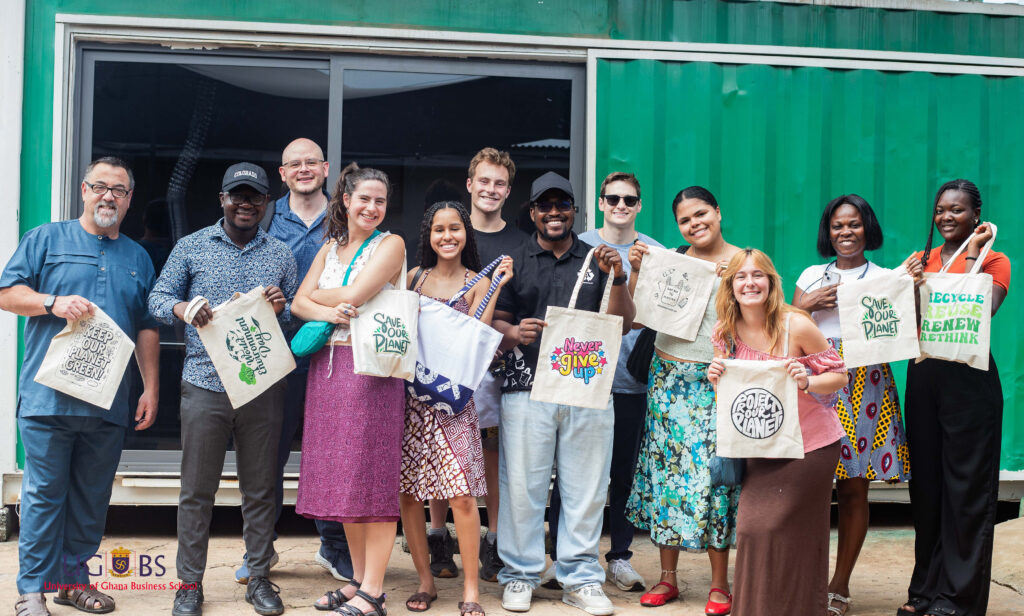
As the rest of the world marked the occasion with pledges and posts, we marked it the way we know best: with fabric, ink, conversation, and the kind of hands-on energy that makes ideas real. Our guests were a group of summer interns from Marist University in New York — bright, curious, globally minded young people who had travelled to Ghana and were spending part of their summer gaining practical experience in West Africa.
Hosting them on World Environment Day felt like more than a happy coincidence. It felt like exactly the kind of moment our work is built for.
The interns arrived at our workspace with a mix of curiosity and openness that is the hallmark of students who are genuinely here to learn. For many of them, this was their first time seeing a small social enterprise operating at close range — not a case study in a textbook, but a real business, on a real street, with real purpose.
We started simply: with a conversation about plastic. About what it costs Ghana. About what it costs the ocean. About the number of single-use plastic bags a typical Ghanaian household moves through in a week, a month, a year — and where those bags end up.
The students leaned in. Questions came quickly. And from that conversation, we moved into showing them what Reusable Bags GH is actually doing about it.
We walked the Marist interns through our entire process — from raw material to finished product — and the tour was full of moments of genuine surprise.
We showed them our cotton and jute fabrics, explaining why natural fibres matter: they are biodegradable, durable, and do not shed microplastics the way synthetic materials do. We showed them our upcycled denim bags, made from fabric sourced at Kantamanto Market here in Accra — one of the world’s largest second-hand clothing markets. Those bags carry two stories at once: the story of reduced plastic waste and the story of textile waste given a second life.
We walked them through cutting, sewing, and finishing. We explained what goes into a custom order — how a business, NGO, or event organiser comes to us wanting something that represents their brand while doing right by the environment. We talked about the balance between quality, affordability, and sustainability that defines every bag that leaves our hands.
“When you hold one of these bags, you are holding a decision. A decision that someone made to do things differently. That is not small — that is the whole point.”
Part of our conversation centred on impact — what Reusable Bags GH has actually achieved since Bismark Osiakwa founded the company in Accra in 2020. We shared some of what we have built together:
But numbers only tell part of the story. We told the students about the small restaurants in Accra that switched their takeaway packaging to our bags. About the event organisers who turned branded giveaways into a sustainability message. About the NGOs working in health and education who came to us because they wanted their communications to reflect their values — right down to what they carry their materials in.
Every one of those partnerships started with someone choosing to do things differently. The Marist interns are part of that same tradition.
We had saved the best for last.
As the visit moved into the afternoon, we set up a hands-on bag printing activity — and invited each intern to print their own tote bag.
The energy in the room shifted completely. These were no longer students observing a presentation — they were makers. One by one, they stepped up, chose their design, positioned their screen, and pressed. The satisfaction on each face as they lifted the screen and saw a clean, sharp print on their own bag was something we will not forget quickly.
Some added their names. Some personalised their designs. Some asked if they could do a second one.
“This bag is going back to New York with me. I am going to use it every time I go to the grocery store and I am going to tell people where it came from.”
That, right there, is the ripple effect of what we do. The bag travels. The story travels with it. And somewhere in a supermarket in New York or a market in Accra, someone asks about it — and a conversation about Ghana, about plastic, about better choices begins.
Reusable Bags GH was built on a simple but radical belief: that a business can be profitable and purposeful at the same time. That you do not have to choose between making money and making a difference.
Hosting the Marist University interns on World Environment Day was a reminder of why that belief matters — and of who is watching.
Social enterprises like ours operate in the gaps that larger businesses and governments move past too quickly. We show up in communities. We run workshops. We partner with schools, hospitals, NGOs, and market traders. We make things with our hands and sell them to people who want to live more thoughtfully. None of that is glamorous in the conventional sense. But it is exactly the kind of work that builds the foundation of a more sustainable economy.
When students from an American university come to Accra and spend a day with us — when they print a bag, ask questions about our supply chain, and leave with a deeper understanding of what eco-friendly enterprise looks like on the ground in West Africa — we are reminded that what we are doing here has reach beyond what we can see.
We are not just making bags. We are making an argument. The argument that Africa has solutions. That small businesses can lead. That young people — whether from Accra or New York — can be agents of real environmental change if they are given the right tools and the right stories.
To the Marist University summer students who spent World Environment Day with us: thank you. Thank you for your questions, your energy, your laughter, and your willingness to get your hands inky.
You came to Ghana to learn. But you gave us something too — the reminder that the work we do here matters to people far beyond our borders, and that the next generation of changemakers is already awake, already asking the right questions, and already ready to act.
We hope every bag you carry home carries that story with it.
“The countdown to a plastic-free future is not waiting for governments or corporations. It is being built, one bag at a time, by people who decided to start.”
Want to bring your school, university, or organisation to visit Reusable Bags GH?
We love hosting groups for tours, workshops, and hands-on bag-making sessions. Reach out at reusablebagsgh@gmail.com or WhatsApp us on +233 53 899 1415.
But numbers only tell part of the story. We told the students about the small restaurants in Accra that switched their takeaway packaging to our bags. About the event organisers who turned branded giveaways into a sustainability message. About the NGOs working in health and education who came to us because they wanted their communications to reflect their values — right down to what they carry their materials in.
Every one of those partnerships started with someone choosing to do things differently. The Marist interns are part of that same tradition.
We had saved the best for last.
As the visit moved into the afternoon, we set up a hands-on bag printing activity — and invited each intern to print their own tote bag.
The energy in the room shifted completely. These were no longer students observing a presentation — they were makers. One by one, they stepped up, chose their design, positioned their screen, and pressed. The satisfaction on each face as they lifted the screen and saw a clean, sharp print on their own bag was something we will not forget quickly.
“This bag is going back to New York with me. I am going to use it every time I go to the grocery store and I am going to tell people where it came from.”
That, right there, is the ripple effect of what we do. The bag travels. The story travels with it. And somewhere in a supermarket in New York or a market in Accra, someone asks about it — and a conversation about Ghana, about plastic, about better choices begins.
Reusable Bags GH was built on a simple but radical belief: that a business can be profitable and purposeful at the same time. That you do not have to choose between making money and making a difference.
Hosting the Marist University interns on World Environment Day was a reminder of why that belief matters — and of who is watching.
Social enterprises like ours operate in the gaps that larger businesses and governments move past too quickly. We show up in communities. We run workshops. We partner with schools, hospitals, NGOs, and market traders. We make things with our hands and sell them to people who want to live more thoughtfully. None of that is glamorous in the conventional sense. But it is exactly the kind of work that builds the foundation of a more sustainable economy.
When students from an American university come to Accra and spend a day with us — when they print a bag, ask questions about our supply chain, and leave with a deeper understanding of what eco-friendly enterprise looks like on the ground in West Africa — we are reminded that what we are doing here has reach beyond what we can see.
We are not just making bags. We are making an argument. The argument that Africa has solutions. That small businesses can lead. That young people — whether from Accra or New York — can be agents of real environmental change if they are given the right tools and the right stories.
To the Marist University summer interns who spent World Environment Day with us: thank you. Thank you for your questions, your energy, your laughter, and your willingness to get your hands inky.
You came to Ghana to learn. But you gave us something too — the reminder that the work we do here matters to people far beyond our borders, and that the next generation of changemakers is already awake, already asking the right questions, and already ready to act.
We hope every bag you carry home carries that story with it.
“The countdown to a plastic-free future is not waiting for governments or corporations. It is being built, one bag at a time, by people who decided to start.”
Want to bring your school, university, or organisation to visit Reusable Bags GH?
We love hosting groups for tours, workshops, and hands-on bag-making sessions. Reach out at reusablebagsgh@gmail.com or WhatsApp us on +233 53 899 1415.
Connect with us on Instagram